Welcome to Wisefluid
Laboratory Gas Supply Systems
1. Types of Gases Used in Laboratories
- Gas Chromatograph (GC): Nitrogen (N₂), helium (He), or xenon (Xe) as carrier gases; hydrogen (H₂) as fuel gas for flame detectors.
- Mass Spectrometer (MS): High-purity argon (Ar) or nitrogen (N₂) as purge or collision gases.
- Atomic Absorption Spectrometer (AAS): Acetylene (C₂H₂) with oxygen (O₂) or nitrous oxide (N₂O) as auxiliary fuels.
- Gas Chromatography-Mass Spectrometry (GC-MS): Ammonia (NH₃) as a carrier gas; nitrogen (N₂) or ammonia (NH₃) as collision gases in triple quadrupole mass spectrometers.
- Liquid Chromatograph (HPLC): Nitrogen (N₂) for evaporative light scattering detectors.
- Atomic Fluorescence Lab: Argon (Ar) and liquefied petroleum gas (LPG) as fuel gases.
- Nitrogen Evaporator: Nitrogen (N₂).
2. Laboratory Gas Supply Modes
Laboratory gas supply systems are categorized into decentralized and centralized modes.
(1) Decentralized Gas Supply
Gas cylinders or generators are placed in individual instrument rooms near usage points.
Advantages: Convenient access, gas efficiency, low initial cost.
Safety Requirements:
- Explosion-proof gas cylinder cabinets with alarm systems (combustible/non-combustible gas detectors) and venting systems.
- Clear safety labels and secure cylinder fixation in cabinets.
(2) Centralized Gas Supply
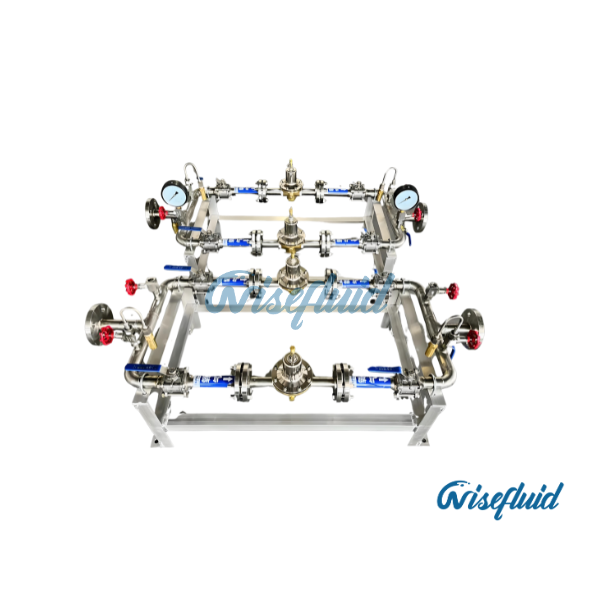
All gas cylinders are stored in a dedicated external gas room. Gases are delivered via pipelines to two-stage pressure regulation/distribution units (function columns) and terminal connections (joints, shut-off valves).
System Components:
- Gas manifold system.
- High-purity gas pipelines (BA&EP-grade stainless steel, ensuring airtightness, cleanliness, durability, and safety).
- Continuous gas supply with adjustable pressure/flow rates to meet varying experimental demands.
3. Key Design Considerations for Centralized Gas Supply
Uninterrupted Supply: Semi-automatic switching systems and multi-cylinder setups ensure constancy.
Safety and Efficiency:
- Centralized cylinder storage eliminates in-lab hazards and optimizes space.
- Safety valves, nitrogen purge functions maintain gas purity.
- Low-pressure alarms prompt timely cylinder replacement.
Material and Connection Standards:
- Pipeline materials (Copper or BA-grade stainless steel) tailored to gas types.
- High-pressure valves for critical sections; automatic welding for secure joints.
- Flame arrestors in pipelines for combustible gases (e.g., H₂, C₂H₂).
Control Systems:
- PLC (Programmable Logic Controller) integration for gas alarms, emergency shut-off, and venting.
- Pneumatic valves for H₂ and C₂H₂, synchronized with PLC controls.
Pipeline Layout:
- Pipe diameter selected based on gas flow rates.
4. Advantages of Centralized Gas Supply
Enhanced Safety: Isolating gas sources in dedicated rooms reduces direct exposure to hazards.
High Gas Purity: BA-grade seamless stainless steel pipes with nitrogen purge minimize contamination risks.
System Stability: Two-stage pressure reduction and precise flow/pressure controls ensure consistent output.
Ease of Management: Centralized monitoring and maintenance streamline operations.
Space Efficiency: Eliminates in-lab cylinders and optimizes pipeline layouts for large facilities.