Welcome to Wisefluid
Gas Manifold Systems in Modern Industry and Healthcare
In modern industrial production and medical facilities, efficient, safe, and uninterrupted gas supply is critical to ensuring stable operational workflows and safeguarding patient safety and care quality. Gas manifold systems, as centralized gas supply devices, play a vital role in these settings and have gained increasing attention and recognition.
Working Principle of Gas Manifold Systems
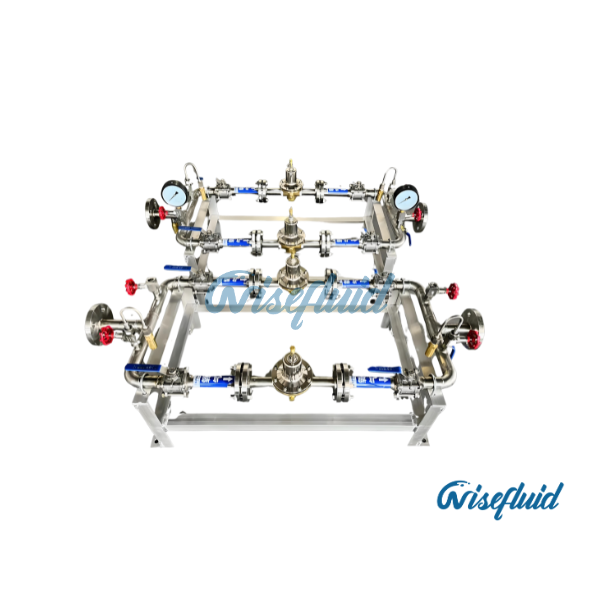
The core function of a gas manifold system is to efficiently collect high-pressure gas from multiple cylinders and distribute it through a well-designed pipeline network to various usage points. This process involves not only physical connections but also precise regulation of gas pressure and flow rates. Specifically, high-pressure gas from different cylinders is first channeled into the main pipeline of the manifold. It then passes through pressure-reducing devices to adjust the pressure to levels suitable for end-use equipment. Throughout this process, the system is equipped with precision pressure gauges and regulators to ensure stable and safe gas supply. Advanced manifolds also feature automatic switching functions. When one cylinder is depleted, the system seamlessly switches to a backup cylinder, ensuring continuous gas supply.
Advantages of Gas Manifold Systems
1. Enhanced Efficiency: Centralized gas management and supply significantly reduce the frequency of cylinder replacements, freeing up human resources and allowing staff to focus on higher-value tasks.
2. Improved Safety: Centralized systems minimize risks associated with scattered cylinder storage, such as fire or explosion hazards, while enabling more effective monitoring and maintenance.
3. Space Optimization: Compared to traditional scattered cylinder storage, manifold systems have a compact design, making them ideal for space-constrained environments.
4. Simplified Management: Centralized supply streamlines gas distribution and monitoring, simplifying maintenance and usage tracking.
Classification and Applications of Gas Manifold Systems
Gas manifold systems are categorized based on structure and application, including oxygen, hydrogen, and nitrogen manifolds, each tailored to the specific properties of the gas they handle. For example, in healthcare, oxygen manifolds are widely used in operating rooms and ICUs to ensure reliable oxygen supply for patients. In the chemical industry, hydrogen manifolds are essential for supporting chemical reactions. Additionally, technological advancements have introduced semi-automatic and fully automatic switching systems, further enhancing operational intelligence and user experience.
Conclusion
In summary, gas manifold systems are indispensable in modern industrial and medical fields. They improve efficiency, safety, space utilization, and management effectiveness. As technology evolves, future systems will become more intelligent and integrated, delivering even greater convenience and efficiency. Whether in manufacturing or healthcare, selecting and implementing the right gas manifold system is key to enhancing overall operational performance.