Welcome to Wisefluid
System Components of Pressure Reduction Skids
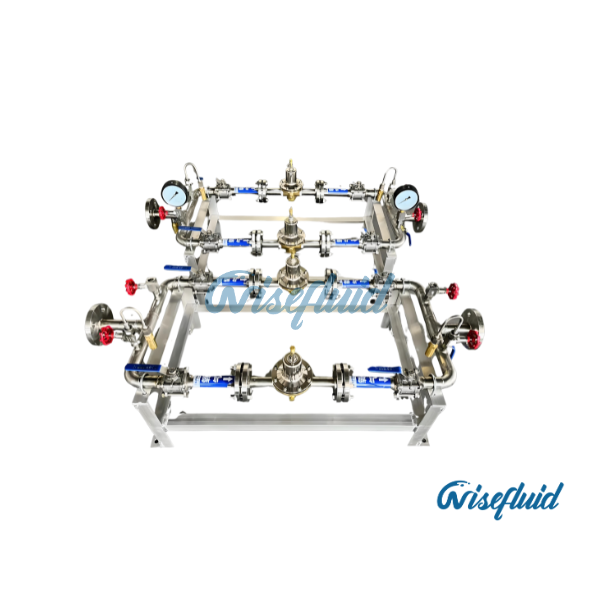
A pressure reduction skid is an essential piece of equipment when it comes to ensuring safe and efficient gas delivery in industrial or commercial environments. These skids are engineered to manage high-pressure gas flow and reduce it to a usable, stable level tailored to downstream requirements. But what makes these systems reliable and effective? The answer lies in their components.
In this article, we’ll break down the system components of a pressure reduction skid, explaining the role each part plays in maintaining performance, safety, and regulatory compliance. Whether you're a plant engineer, procurement manager, or system designer, understanding these elements is key to selecting or maintaining the right solution for your operation.
System Components
1. Pressure Regulation Module
Core Function
Serves as the "heart" of the pressure reduction skid, responsible for accurate adjustment of gas pressure.
Key Components and Functions
Pressure Regulator
Function: Automatically adjusts gas flow according to the set pressure, reducing high-pressure gas from the upstream (e.g., from 10 MPa down to 0.4 MPa) to meet downstream requirements.
Types:
Direct-acting regulator: Uses mechanical force from a spring and diaphragm to regulate pressure. Simple structure, suitable for low-pressure applications.
Pilot-operated regulator: Uses a pilot (auxiliary controller) to amplify signals, providing higher accuracy and stability, suitable for medium to high-pressure systems.
Safety Shut-off Valve
Function: Automatically and quickly cuts off the gas flow when pressure exceeds safety thresholds (overpressure or underpressure), protecting pipelines and equipment from damage and avoiding safety incidents.
Relief Valve
Function: Automatically vents excess gas when system pressure exceeds a preset level, preventing continuous pressure build-up and ensuring system safety.
2. Filtration Module
Core Function
Removes solid impurities (e.g., dust, rust, welding slag) and liquid contaminants (e.g., water, oil) from the gas to ensure cleanliness and protect downstream equipment such as regulators and flow meters.
Key Components and Functions
Gas Filter
Structure: Usually a cartridge-type housing with an internal filter element (e.g., metal mesh or coalescing filter).
Function: Traps impurities in the gas. Filter elements can be regularly cleaned or replaced.
Differential Pressure Gauge
Function: Monitors the pressure difference across the filter. When the differential exceeds a preset value, it indicates that the filter element requires maintenance or replacement.
3. Measurement Module
Core Function
Accurately measures gas flow for purposes such as commercial transactions, process control, or energy consumption management.
Key Components and Functions
Flow Meter
Types:
Turbine Flow Meter: High accuracy and fast response; suitable for clean, low-viscosity gases.
Ultrasonic Flow Meter: No moving parts, minimal pressure loss; ideal for large-volume gas measurement.
Orifice Plate Flow Meter: Simple structure, low cost; suitable for high-pressure gas measurement.
Function: Measures gas flow in real time and transmits data to control systems or display terminals.
Temperature / Pressure Transmitters
Function: Compensate for temperature and pressure variations, correcting flow measurements to ensure accuracy (since gas volume is significantly affected by temperature and pressure).
4. Odorization Module
Core Function
Injects odorant (e.g., tetrahydrothiophene) into odorless gases like natural gas, providing a distinct smell for leak detection and enhancing user safety.
Key Components and Functions
Odorant Tank
Function: Stores liquid odorant. Typically made from corrosion-resistant materials such as stainless steel.
Odorant Pump
Function: Injects odorant into the gas pipeline at a controlled rate based on the set flow. Injection quantity can be precisely adjusted via the control system.
5. Control and Monitoring Module
Core Function
Enables automated operation, parameter monitoring, and remote control of the pressure reduction skid, improving system stability and maintenance efficiency.
Key Components and Functions
Control System (PLC/DCS)
Function: A logic control unit that receives sensor inputs (e.g., pressure, flow, temperature), automatically adjusts regulators and valves, and provides alarm and protection features.
Human-Machine Interface (HMI)
Function: An operator panel or touchscreen used to display real-time parameters (e.g., pressure, flow, temperature), set control values, and view historical data or fault records.
Remote Monitoring System
Function: Uses IoT (Internet of Things) technology to transmit skid data to the cloud or monitoring center. Supports remote start/stop, parameter adjustments, and fault alerts (accessible via mobile apps or computer platforms).
6. Heating Module
Heating module is a special part of a skid. Whether a gas pressure regulating skid requires heating depends on the type of gas being handled, the pressure drop range, and the specific application environment.
Common Situations Where Heating Is Not Required
1. Handling Standard Natural Gas (No Risk of Hydrocarbon Condensation)
Natural gas is mainly methane, which has a critical temperature of -82.6°C. Under normal ambient temperatures (0–40°C) and typical pressure reduction (e.g., from 10 MPa to 0.4 MPa), methane will not liquefy. So heating is not needed.
Example: City gas regulating stations and low-pressure industrial users usually only require basic functions like filtration, pressure regulation, and metering.
2. Gas Is Well Above Critical Temperature & Pressure Drop Is Small
If the gas (e.g., compressed air or nitrogen) starts off warm, and the pressure drop is minor (e.g., from 2 MPa to 0.5 MPa), the cooling effect is minimal. There's no condensation risk, so heating is unnecessary.
3. Design Measures to Avoid Low Temperatures
Some skids use layout optimization, shorter gas paths, or materials suitable for low temperatures (like stainless steel) to minimize temperature loss. In such cases, heating can be skipped.
Special Cases Where Heating Is Required
Heating is needed when handling certain gases or working under special conditions:
1. High-Pressure Natural Gas with Liquids (e.g., Wet Gas, LNG Vapor)
Problem: If natural gas contains heavier components like ethane or propane, pressure drop can cause rapid temperature drops due to the Joule–Thomson effect. This may lead to liquid hydrocarbons forming, which can block pipes or damage regulators.
Solution: Use electric heaters or hot water bath heaters to raise the gas temperature and prevent condensation.
Examples:
LNG vaporizing stations: After vaporization, gas pressure may increase to over 4 MPa. Heating may be required during pressure reduction.
Oilfield associated gas: Wet gas with heavy components often needs pre-heating before pressure reduction.
2. Special Gases Like Hydrogen or Helium Under High Pressure
Hydrogen: Its critical temperature is -240°C, so heating is usually unnecessary. But if pressure exceeds 100 MPa or the temperature is very low, heating may be required to prevent freezing.
Helium: With a critical temperature of -268.9°C, helium usually doesn't need heating—except in ultra-high-pressure uses like aerospace or research labs.
3. Cold Environments or Low Outdoor Temperatures
In very cold areas (e.g., below -30°C), even standard natural gas can cool down too much during pressure drop. Moisture may freeze and crack pipes or devices. In these cases, heat-tracing systems (like electric heat tape) are needed to keep the system warm.
Common Types of Heating Equipment in Pressure Regulating Skids
If heating is needed, these are the main options:
1. Electric Heaters
How it works: Uses heating elements (like resistance wires or infrared units) to directly heat the gas pipes.
Features: Compact, precise temperature control. Good for small to medium gas flows. Explosion-proof design is needed in flammable environments like natural gas.
2. Hot Water or Steam Bath Heating
How it works: Gas pipes are surrounded by a heating jacket through which hot water or steam circulates.
Features: Provides even heating. Suitable for large gas flows. Requires an external heat source like a boiler. Common in industrial gas plants.
3. Thermal Fluid (Heat Transfer Oil) Heating
How it works: Uses heat transfer oil to deliver high, stable heat to the gas line.
Features: Ideal for applications needing higher gas temperatures, such as special process gases.
Summary: When to Include Heating in a Pressure Regulating Skid
Key factors to consider:
Gas composition
Initial pressure and temperature
Pressure drop range
Ambient temperature
Risk of condensation or freezing
Standard skid designs are typically made for clean gases like natural gas or industrial gases with no condensation risk, so heating is not included by default.
In special conditions—such as wet gas, extreme pressure drops, or cold environments—custom heating systems are required. This should be clearly specified in tenders or technical specifications.
When heating is used, it should be integrated with temperature sensors and control systems to keep gas temperature within safe operating limits.
Conclusion
Understanding the system components of a pressure reduction skid provides valuable insight into how gas control systems operate under real-world conditions. Each component—from pressure regulators and filters to safety valves and control panels—works together to ensure accurate pressure control, safety, and long-term reliability. If you're planning to upgrade your gas supply infrastructure or need a tailored solution for your next project, make sure to choose a skid that’s engineered with the right components for your specific application.
Want expert advice or a customized quote? Contact our team today to explore our full range of modular gas control systems designed for performance, compliance, and ease of installation.